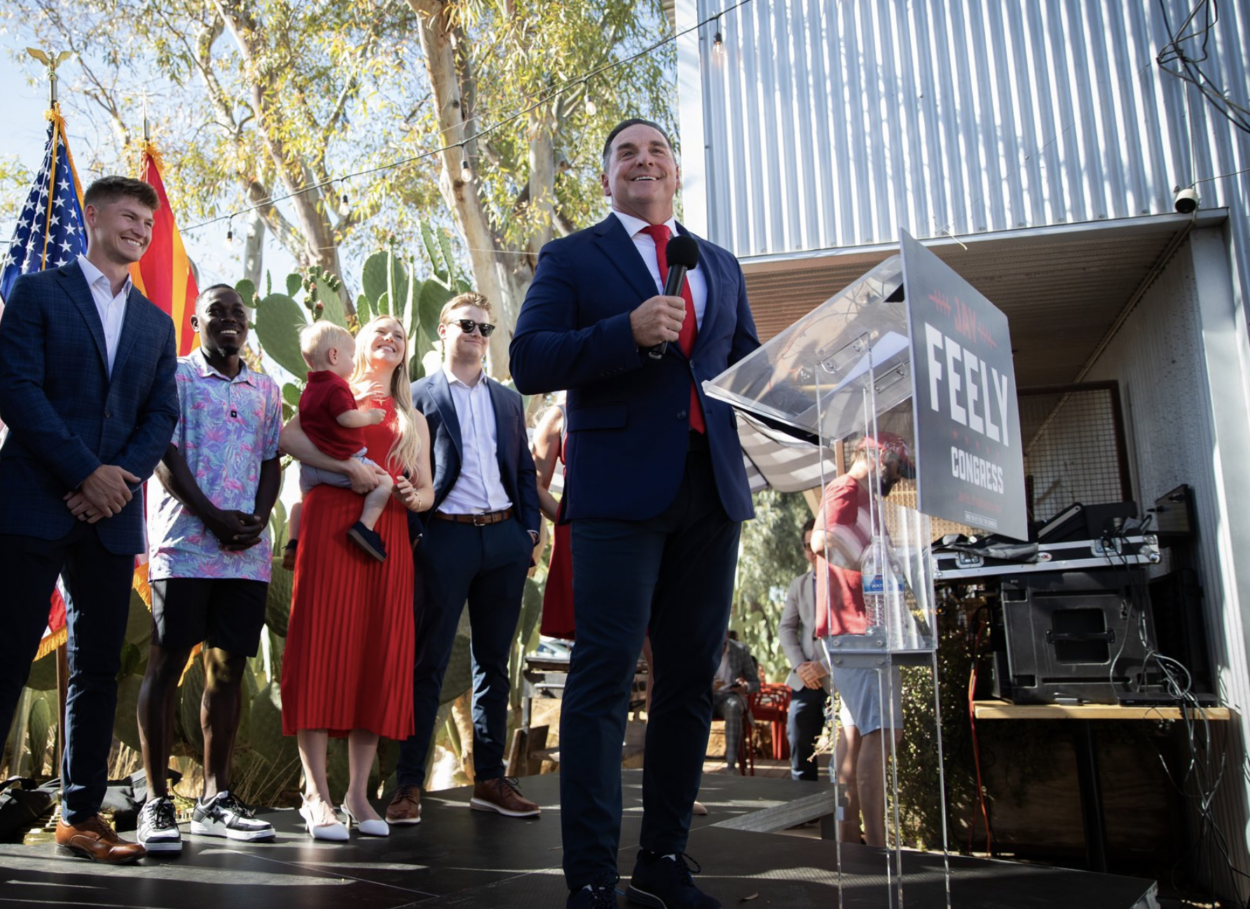


With just under a month left, Arizona's First Congressional District will vote in November on who to send to Washington: Democrat Dr. Amish Shah or Republican Jay Feely.
A poll gave Shah a tiny lead, but will last week's debate give Feely the edge?
The Poll
A FirstStrategic Poll from October 5th gives Shah a tiny two-point lead of 44% over Feely (42%), and Polymarket gives him a healthy 78% chance of winning in November to Feely's 23%.
Even with Polymarket's odds, other pollsters consider the race a toss-up, and both candidates have sizable war chests.
That's where last week's debate comes in.
The Debate
Last week, Feely and Shah faced off in their candidates' debate, where they found common ground on water policy, preventing Iran from attaining nuclear weapons (even if Shah argued the Trump Administration bungled the conflict), and keeping illegal aliens off Medicaid.
But Feely got the drop on Shah on data centers.
"AI is coming at us quick, and we are going to need data centers," Shah said. "I just don't want them in CD 1."
Feely noted that Shah voted in favor of granting tax breaks to data centers as a state legislator, calling him "really hypocritical," although Shah replied that "at that time, when we had those tax credits come up, AI wasn't on the radar."
Additionally, when Shah voiced support for DACA recipients ("Dreamers") and guest workers, Feely replied, "The reality is if the Democrat Party — if they get back in control — will open the borders again."
Previous Attacks
Feely previously swiped at Shah as a "Bernie Sanders guy" who "has been for the last ten years. Capitalism and free markets against socialism. Rational people will choose common-sense beliefs and free market capitalism."
Shah's stances on social issues has been under scrutiny, as he notably voted against House Bill 2312 in 2023, which exempted women's domestic violence shelters from gender discrimination lawsuits if they prohibited biological male employees or individuals from entering.
He justified it as "if I have a business of any kind, I can't say I'm only going to take on men or I'm only going to take on women, as far as I understand federal law. And that's where I'm kind of concerned: The way this is written, what it's going to do—is it going to say, well, it allows me to then go against what is established federal law?"