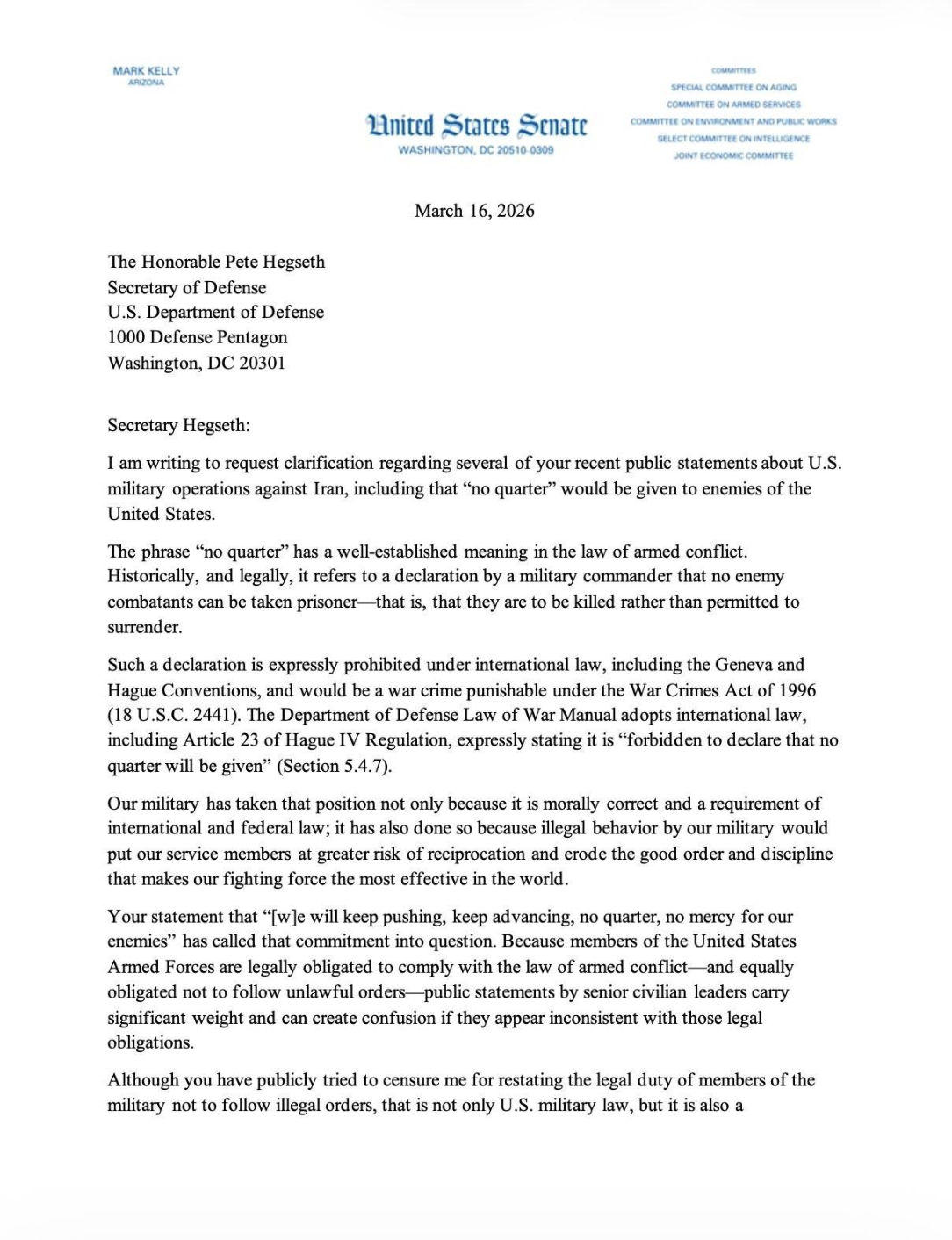


Senator Mark Kelly (D-AZ) is calling on Defense Secretary Pete Hegseth to clarify what he meant when he publicly declared there would be "no quarter" shown to enemies of the United States.
In a formal letter sent to Hegseth at the Pentagon, Kelly argued that the phrase has a well-established meaning in military law: a declaration that enemy combatants will be killed rather than allowed to surrender.
That practice, Kelly wrote, is expressly prohibited under the Geneva and Hague Conventions, and would constitute a war crime punishable under the War Crimes Act of 1996.
"Secretary Hegseth needs to explain exactly what he meant when he said '”no quarter”,” Kelly posted on X alongside the letter. "It's well established that it means to take no prisoners — to kill them instead of accept their surrender. That is illegal under U.S. and international law, would put our servicemembers at greater risk, and erodes the good order and discipline of the best military in the world."
Kelly's Experience
Kelly, a retired Navy combat pilot and former NASA astronaut, pointed to the Department of Defense's own Law of War Manual, which explicitly states it is "forbidden to declare that no quarter will be given."
He argued that public statements from senior civilian leaders carry significant weight and can create confusion among service members who are legally obligated to follow only lawful orders.
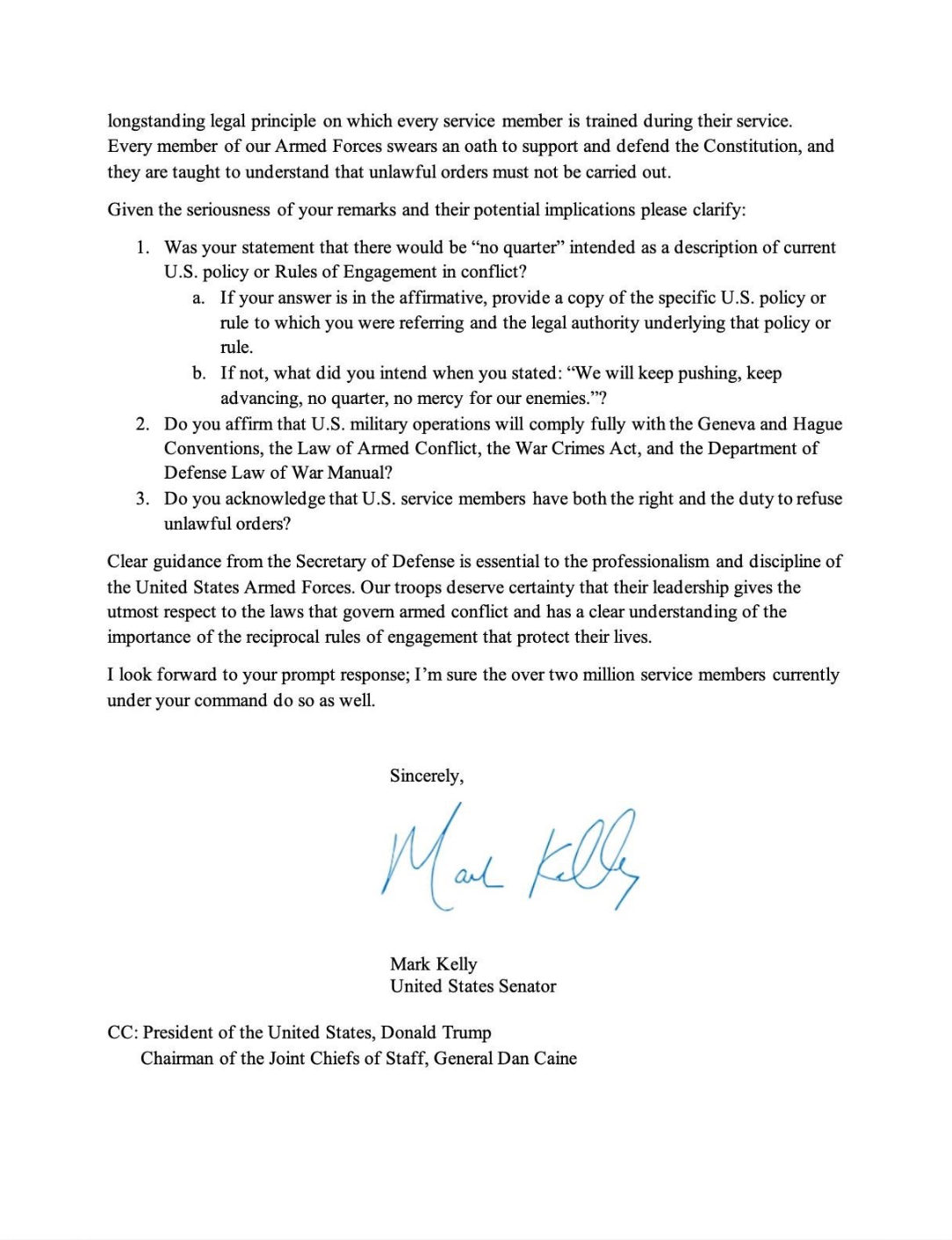
The letter poses three direct questions to Hegseth:
- What did you intend when you stated: "We will keep pushing, keep advancing, no quarter, no mercy for our enemies."?
- Do you affirm that U.S. military operations will comply fully with the Geneva and Hague Conventions, the Law of Armed Conflict, the War Crimes Act, and the Department of Defense Law of War Manual?
- Do you acknowledge that U.S. service members have both the right and the duty to refuse unlawful orders?
Kelly noted that Hegseth had publicly criticized him for reiterating that service members are not required to follow illegal orders, a principle, Kelly said, that is not only federal law but a cornerstone of military training.
Hegseth's office has not publicly responded to the letter.