

Representative Ralph Heap (R-AZ) is pushing back against what he calls the "worst possible locations” for the solar industry in how the state manages its land.
Rep. Heap introduced House Bill 2975 this past week, requiring the Arizona State Land Department to suspend a controversial map that highlights prime locations for solar farms. The bill also requires the department to create similar maps for homebuilding and mining.
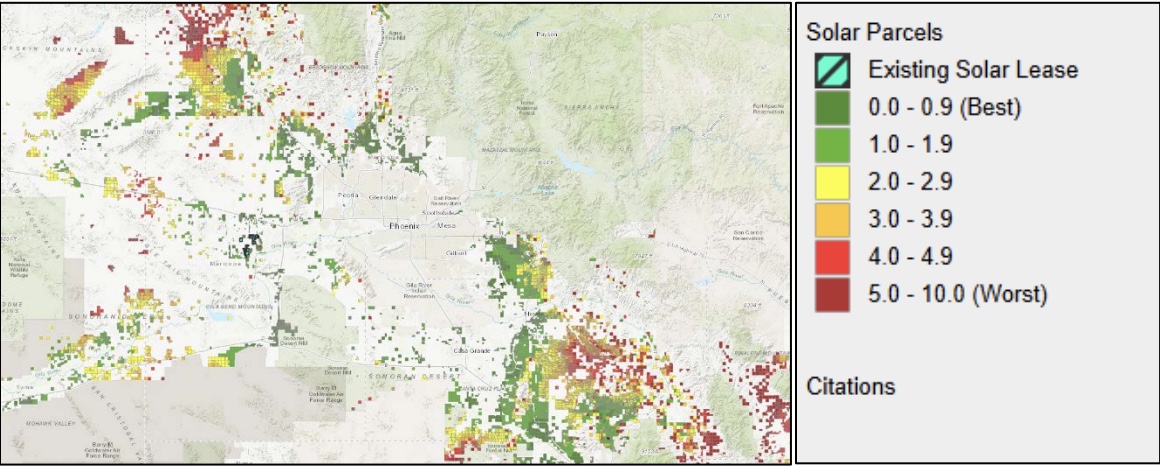
At the center of the debate is the "Solar Scores" map. This map rates state-owned land on a scale of 0 to 10, with the best locations for solar panels marked in green. The problem, according to Heap, is that no equivalent maps exist for housing, mining, or agriculture.
"By designating a map for solar, but not other industries, the Hobbs administration is effectively declaring solar the preferred use of this land," Heap explained.
Spencer Kamps, vice president of the Home Builders Association of Central Arizona, warned that this gives solar companies an illicit advantage.
"In the absence of a similar map for other industries, some might say the solar map is serving functionally as a 'presumptive highest and best use map,'" Kamps described.
Placement Problems
The controversy connects to Arizona's housing affordability crisis and to the fact that these prime solar spots are located near homes or where new housing is planned.
"For many residents, these parcels are among the worst possible locations for utility-scale solar: near established residential neighborhoods, directly in the path of growth, and on land that could otherwise support new housing," Heap stated.
The solar map came from Governor Katie Hobbs' (D-AZ) energy agenda, when she ordered the land department to accelerate renewable energy projects on state property.
Therefore, Heap accused the governor of prioritizing special interests over affordability.
"Governor Hobbs hasn't made affordability a priority. Instead, her administration is focused on handing out sweetheart deals to her friends in the renewable energy industry," Heap claimed.
The land department faces broader scrutiny. A legislative oversight committee recently renewed the agency for only four years instead of the typical eight, citing "deep, longstanding issues."
Representative Gail Griffin (R-AZ) then criticized the agency's leadership: "The Commissioner acknowledged these issues during her confirmation hearing and committed to fixing them, but they haven't been fixed."
If passed, HB 2975 would immediately suspend the Solar Scores map and require the development of comparable planning tools for other industries.